Hungary
Revolution of 1956
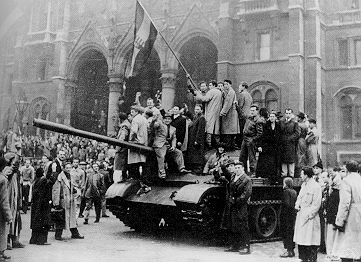 On
October 23, a Budapest student rally in support of Polish efforts to win
autonomy from the Soviet Union sparked mass demonstrations. The police attacked,
and the demonstrators fought back, tearing down symbols of Soviet domination,
sacking the party newspaper's offices and shouting in favor of free elections,
and national independence. Gero called out the army, but many soldiers handed
their weapons to the demonstrators and joined the uprising. Soviet officials in
Budapest tried to speak to the crowd, but the violence continued. At Gero's
request, Soviet troops entered Budapest on October 24. The presence of these
troops further enraged the Hungarians, who battled the troops and state security
police. Crowds emptied the prisons, freed Cardinal Mindszenty, sacked police
stations, and summarily hanged some member of the secret police. The Central
Committee named Nagy prime minister on October 25 and selected a new Politburo
and Secretariat; one day later, Kadar replaced Gero as party first secretary.
On
October 23, a Budapest student rally in support of Polish efforts to win
autonomy from the Soviet Union sparked mass demonstrations. The police attacked,
and the demonstrators fought back, tearing down symbols of Soviet domination,
sacking the party newspaper's offices and shouting in favor of free elections,
and national independence. Gero called out the army, but many soldiers handed
their weapons to the demonstrators and joined the uprising. Soviet officials in
Budapest tried to speak to the crowd, but the violence continued. At Gero's
request, Soviet troops entered Budapest on October 24. The presence of these
troops further enraged the Hungarians, who battled the troops and state security
police. Crowds emptied the prisons, freed Cardinal Mindszenty, sacked police
stations, and summarily hanged some member of the secret police. The Central
Committee named Nagy prime minister on October 25 and selected a new Politburo
and Secretariat; one day later, Kadar replaced Gero as party first secretary.
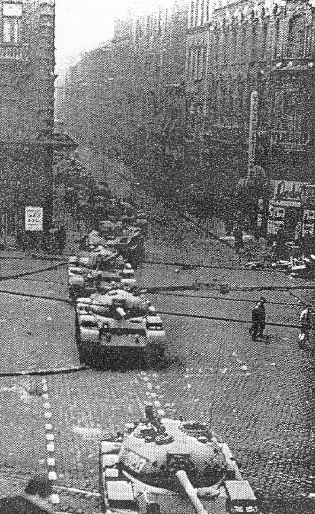 Nagy
enjoyed vast support. He formed a new government consisting of both communists
and noncommunists, dissolved the state security police, abolished the one-party
system, and promised free elections and an end to collectivization, all with
Kadar's support. But Nagy failed to harness the popular revolt. Workers'
councils threatened a general strike to back demands for removal of Soviet
troops, elimination of party interference in economic affairs, and renegotiation
of economic treaties with the Soviet Union. On October 30, Nagy called for the
formation of a new democratic, multiparty system. Noncommunist parties that had
been suppressed almost a decade before began to reorganize. A coalition
government emerged that included members of the Independent Smallholders' Party,
Social Democratic Party, National Peasant Party, and other parties, as well as
the HWP. After negotiations, Soviet officials agreed to remove their troops at
the discretion of the Hungarian government, and Soviet troops began to leave
Budapest. Nagy soon learned, however, that new Soviet armored divisions had
crossed into Hungary.
Nagy
enjoyed vast support. He formed a new government consisting of both communists
and noncommunists, dissolved the state security police, abolished the one-party
system, and promised free elections and an end to collectivization, all with
Kadar's support. But Nagy failed to harness the popular revolt. Workers'
councils threatened a general strike to back demands for removal of Soviet
troops, elimination of party interference in economic affairs, and renegotiation
of economic treaties with the Soviet Union. On October 30, Nagy called for the
formation of a new democratic, multiparty system. Noncommunist parties that had
been suppressed almost a decade before began to reorganize. A coalition
government emerged that included members of the Independent Smallholders' Party,
Social Democratic Party, National Peasant Party, and other parties, as well as
the HWP. After negotiations, Soviet officials agreed to remove their troops at
the discretion of the Hungarian government, and Soviet troops began to leave
Budapest. Nagy soon learned, however, that new Soviet armored divisions had
crossed into Hungary.
In response, on
November 1 Nagy announced Hungary's decision to withdraw from the
Warsaw Pact (see Glossary) and to declare
Hungary neutral. He then appealed to the United Nations and Western governments
for protection of Hungary's neutrality. The Western powers, which were involved
in the Suez crisis and were without contingency plans to deal with a revolution
in Eastern Europe, did not respond.
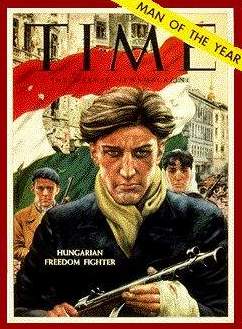
The
Soviet military responded to Hungarian events with a quick strike. On November
3, Soviet troops surrounded Budapest and closed the country's borders. Overnight
they entered the capital and occupied the National Assembly building. Kadar, who
had fled to the Soviet Union on November 2, assembled the Temporary
Revolutionary Government of Hungary on Soviet soil just across the Hungarian
border. On November 4, the formation of the new government was announced in a
radiobroadcast. Kadar returned to Budapest in a Soviet armored car; by then,
Nagy had fled to the Yugoslav embassy, Cardinal Mindszenty had taken refuge in
the United States embassy, Rakosi was safely across the Soviet border, and about
200,000 Hungarians had escaped to the West.
With Soviet support,
Kadar struck almost immediately against participants in the revolution. Over the
next five years, about 2,000 individuals were executed and about 25,000
imprisoned. Kadar also reneged on a guarantee of safe conduct granted to Nagy,
who was arrested on November 23 and deported to Romania. In June 1958, the
Hungarian government announced that Nagy and other government officials who had
played key roles in the revolution had been secretly tried and executed.