Islam
Religion and Philosophy
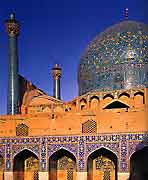
Islam is
Christianity’s only rival as a world religion in
the vigour and range of its geographical spread.
It springs ultimately from the same roots as Christianity, the tribal
cultures of the Semitic peoples of the
The Five Pillars
The religious
duties and beliefs of a Moslem are known as the Five Pillars of Islam. The
word Islam means submission to the will of God.
Despite a
rich diversity in Islamic practice, there are five simple required observances
prescribed in the Quran that all practicing Muslims accept
and follow. These "Pillars of Islam" represent the core and common
denominator that unites all Muslims and distinguishes Islam from other
religions. Following the Pillars of Islam requires dedication of your mind,
feelings, body, time, energies, and possessions. Meeting the obligations
required by the Pillars reinforces an ongoing presence of God in Muslims'
lives and reminds them of their membership in a single worldwide community of
believers.
1. The first pillar is called the Declaration of Faith . A Muslim is
one who bears witness, who testifies that "there is no god but God [Allah] and
Muhammad is the messenger of God." This declaration is known as the
shahada (witness,
testimony) . Allah is the Arabic name for God, just as Yahweh is the
Hebrew name for God used in the Old Testament. To become a Muslim, one need
only make this simple proclamation.
The first part of this proclamation affirms Islam's absolute monotheism, the
uncompromising belief in the oneness or unity of God, as well as the doctrine
that association of anything else with God is idolatry and the one
unforgivable sin. As we see in Quran 4:48 :
"God does not forgive anyone for associating something with Him, while He does forgive whomever He wishes to for anything else. Anyone who gives God associates [partners] has invented an awful sin."
This helps us
to understand the Islamic belief that its revelation is intended to correct
such departures from the "straight path" as the Christian concept of the
Trinity and veneration of the Virgin Mary in Catholicism.
The second part of the confession of faith asserts that Muhammad is not only a
prophet but also a messenger of God, a higher role also played by Moses and
Jesus before him. For Muslims, Muhammad is the vehicle for the last and final
revelation. In accepting Muhammad as the "seal of the prophets," they believe
that his prophecy confirms and completes all of the revealed messages,
beginning with Adam's. In addition, somewhat like Jesus Christ, Muhammad
serves as the preeminent role model through his life example. The believer's
effort to follow Muhammad's example reflects the emphasis of Islam on practice
and action. In this regard Islam is more like Judaism, with its emphasis upon
the law, than Christianity, which gives greater importance to the importance
of doctrines or dogma. This practical orientation of Islam is reflected in the
remaining four Pillars of Islam.
2. The second Pillar of Islam is Prayer ( salat
). Muslims pray (or, perhaps more correctly, worship) five times throughout
the day: at daybreak, noon, midafternoon, sunset, and evening. Although the
times for prayer and the ritual actions were not specified in the Quran,
Muhammad established them.
In many Muslim countries, reminders to pray, or "calls to prayer" echo out
across the rooftops. Aided by a megaphone, from high atop a mosque's minaret,
the muezzin calls out:
God is most great [ Allahu Akbar ], God is most great, God is most great, God is most great, I witness that there is no god but God [ Allah ]; I witness that there is no god but God. I witness that Muhammad is the messenger of God. I witness that Muhammad is the messenger of God. Come to prayer; come to prayer! Come to prosperity; come to prosperity! God is most great. God is most great. There is no god but God.
These reminders throughout the day help to keep believers mindful of God in
the midst of everyday concerns about work and family with all their
attractions and distractions. It strengthens the conscience, reaffirms total
dependence on God, and puts worldly concerns within the perspective of death,
the last judgment, and the afterlife.
The prayers consist of recitations from the Quran in Arabic and glorification
of God. These are accompanied by a sequence of movements: standing, bowing,
kneeling, touching the ground with one's forehead, and sitting. Both the
recitations and accompanying movements express submission, humility, and
adoration of God. Muslims can pray in any clean environment, alone or
together, in a mosque or at home, at work or on the road, indoors or out. It
is considered preferable and more meritorious to pray with others, if
possible, as one body united in the worship of God, demonstrating discipline,
brotherhood, equality, and solidarity.
As they prepare to pray, Muslims face Mecca, the holy city that houses the
Kaaba (the house of God believed to have been built by Abraham and his son
Ismail). Each act of worship begins with the declaration that "God is most
great" (" Allahu Akbar ") and is followed by fixed
prayers that include the opening verse of the Quran.
At the end of the prayer, the shahada (declaration
of faith) is again recited, and the "'peace greeting" - " Peace be upon all of
you and the mercy and blessings of God" is repeated twice.
3. The third Pillar of Islam is called the Zakat,
which means "purification." Like prayer, which is both an individual and
communal responsibility, zakat expresses a
Muslim's worship of and thanksgiving to God by supporting the poor. It
requires an annual contribution of 2.5 percent of an individual's wealth and
assets, not merely a percentage of annual income. In Islam, the true owner of
things is not man but God. People are given their wealth as a trust from God.
Therefore, zakat is not viewed as "charity"; it is an obligation for those who
have received their wealth from God to respond to the needs of less fortunate
members of the community. The Quran (9:60) as
well as Islamic law stipulates that alms are to be used to support the poor,
orphans, and widows, to free slaves and debtors, and to support those working
in the "cause of God" (e.g., construction of mosques, religious schools, and
hospitals, etc.). Zakat, developed fourteen hundred years ago, functions as a
form of social security in a Muslim society. In Shii Islam, in addition to the
zakat, which is not limited to 2.5 percent,
believers pay a religious tax ( khums ) on their
income to a religious leader. This is used to support the poor and needy.
4. The fourth Pillar of Islam, the Fast of Ramadan, occurs once each
year during the month of Ramadan, the ninth month of the Islamic calendar and
the month in which the first revelation of the Quran came to Muhammad. During
this month-long fast, Muslims whose health permits must abstain from dawn to
sunset from food, drink, and sexual activity. Fasting is a practice common to
many religions, sometimes undertaken as penance, sometimes to free us from
undue focus on physical needs and appetites. In Islam the discipline of the
Ramadan fast is intended to stimulate reflection on human frailty and
dependence upon God, focus on spiritual goals and values, and identification
with and response to the less fortunate.
At dusk the fast is broken with a light meal popularly referred to as
breakfast. Families and friends share a special late evening meal together,
often including special foods and sweets served only at this time of the year.
Many go to the mosque for the evening prayer, followed by special prayers
recited only during Ramadan. Some will recite the entire Quran (one-thirtieth
each night of the month) as a special act of piety, and public recitations of
the Quran or Sufi chanting can be heard throughout the evening. Families rise
before sunrise to take their first meal of the day, which must sustain them
until sunset.
Near the end of Ramadan (the twenty-seventh day) Muslims commemorate the
"Night of Power" when Muhammad first received God's revelation. The month of
Ramadan ends with one of the two major Islamic celebrations, the Feast of the
Breaking of the Fast, called Eid al-Fitr, which
resembles Christmas in its spirit of joyfulness, special celebrations, and
gift giving.
5. The fifth Pillar is the Pilgrimage or Hajj
to
The Quran
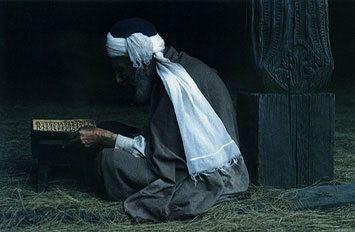
Mohammed’s followers wrote down his prophecies after his death, creating the Quran. Its essence was the assertion that no God was to be worshipped but Allah; Islam was uncompromisingly monotheistic. One objection Moslems had to Christianity was that they believed it to be polytheistic, because it gave as much importance to Jesus and the Holy Spirit as to God the Father.
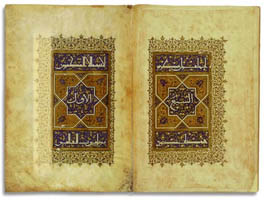
For Muslims, or followers of Islam, the Quran is the actual Word of God revealed through the archangel Gabriel to the Prophet of Islam during the twenty-three-year period of his prophetic mission. It was revealed in the Arabic language as a sonoral revelation which the Prophet repeated to his companions. Arabic became therefore the language of Islam even for non-Arab Muslims. Under the direction of the Prophet, the verses and chapters were organized in the order known to Muslims to this day. There is only one text of the Quran accepted by all schools of Islamic thought and there are no variants. The Quran is the central sacred reality of Islam. The sound of the Quran is the first and last sound that a Muslim hears in this life. As the direct Word of God and the embodiment of God's Will, the Quran is considered as the guide par excellence for the life of Muslims. It is the source of all Islamic doctrines and ethics. Both the intellectual aspects of Islam and Islamic Law have their source in the Quran. Perhaps there is no book revered by any human collectivity as much as the Quran is revered by Muslims. Essentially a religion of the book, Islam sees all authentic religions as being associated with a scripture. That is why Muslims call Christians and Jews the "people of the book". Throughout all its chapters and verses, the Quran emphasizes the significance of knowledge and encourages Muslims to learn and to acquire knowledge not only of God's laws and religious injunctions, but also of the world of nature. The Quran refers, in a language rich in its varied terminology, to the importance of seeing, contemplating, and reasoning about the world of creation and its diverse phenomena. It places the gaining of knowledge as the highest religious activity, one that is most pleasing in God's eyes. That is why wherever the message of the Quran was accepted and understood, the quest for knowledge flourished.
Despite the
recent example of the Taliban in Afghanistan and sporadic conflicts between
Muslims and Christians in Sudan, Nigeria, Pakistan, and Indonesia,
theologically and historically Islam has a long record of tolerance.
The Quran clearly and strongly states that "there is to be no compulsion in
religion" (2:256), and that God has created not
one but many nations and peoples. Many passages underscore the diversity of
humankind. The Quran teaches that God deliberately created a world of
diversity (49:13) :
"O humankind, We have created you male and female and made you nations and tribes, so that you might come to know one another."
Muslims, like
Christians and Jews before them, believe that they have been called to a
special covenant relationship with God, constituting a community of believers
intended to serve as an example to other nations
(2:143) in establishing a just social order
(3:110) .
Moreover, Muslims regard Jews and Christians as "People of the Book," people
who have also received a revelation and a scripture from God (the Torah for
Jews and the Gospels for Christians). The Quran and Islam recognize that
followers of the three great Abrahamic religions, the children of Abraham,
share a common belief in the one God, in biblical prophets such as Moses and
Jesus, in human accountability, and in a Final Judgment followed by eternal
reward or punishment. All share the common hope and promise of eternal reward:
"Surely the believers and the Jews, Christians and Sabians [Middle East groups traditionally recognized by Islam as having a monotheistic orientation], whoever believes in God and the Last Day, and whoever does right, shall have his reward with his Lord and will neither have fear nor regret"
(2:62)
.
Historically, while the early expansion and conquests spread Islamic rule,
Muslims did not try to imposetheir religion on others or force them to
convert. As "People of the Book," Jews and Christians were regarded as
protected people ( dhimmi ), who were permitted to
retain and practice their religions, be led by their own religious leaders,
and be guided by their own religious laws and customs. For this protection,
they paid a poll or head tax ( jizya ). While by
modern standards this treatment amounted to second-class citizenship in
premodern times, it was very advanced. No such tolerance existed in
Christendom, where Jews, Muslims, and other Christians (those who did not
accept the authority of the pope) were subjected to forced conversion,
persecution, or expulsion. Although the Islamic ideal was not followed
everywhere and at all times, it existed and flourished in many contexts.
In recent years, religious intolerance has become a major issue in self-styled
Islamic governments in Saudi Arabia, Afghanistan under the Taliban, Iran, and
Sudan, as well as in the actions of religious extremist organizations from
Egypt's Islamic Jihad to Osama bin Laden and al-Qaeda who have been intolerant
toward not only non-Muslims but also other Muslims who do not accept their
version of "true Islam." The situation is exacerbated in some countries where
Muslims have clashed with Christians (Nigeria, the Philippines, and
Indonesia), Hindus (India and Kashmir), and Jews (Israel). These
confrontations have sometimes been initiated by the Muslim community and
sometimes by the Christian. In some cases it becomes difficult to distinguish
whether conflicts are driven primarily by politics and economics or by
religion. Finally, more secular governments in Egypt, Tunisia, Turkey, Syria,
and elsewhere have often have proven to be intolerant of mainstream Islamic
organizations or parties that offer an alternative vision of society or are
critical of government policies.
From Egypt to Indonesia and Europe to America, many Muslims today work to
reexamine their faith in the light of the changing realities of their
societies and their lives, developing new approaches to diversity and
pluralism. Like Jews and Christians before them, they seek to reinterpret the
sources of their faith to produce new religious understandings that speak to
religious pluralism in the modern world. The need to redefine traditional
notions of pluralism and tolerance is driven by the fact that in countries
such as Egypt, Lebanon, Pakistan, India, Nigeria, Malaysia, and Indonesia,
Muslims live in multireligious societies, and also by new demographic
realities. Never before have so many Muslim minority communities existed
across the world, in particular in America and Europe. The specter of living
as a permanent minority community in non-Muslim countries has heightened the
need to address and redefine questions of pluralism and tolerance. Like Roman
Catholicism in the 1960s, whose official acceptance of pluralism at the Second
Vatican Council was strongly influenced by American Catholics' experience as a
minority, Muslim communities in America and Europe are now struggling with
their questions of identity and assimilation.
Reformers emphasize that diversity and pluralism are integral to the message
of the Quran, which teaches that God created a world composed of different
nations, ethnicities, tribes, and languages:
"To each of you We have given a law and a way and a pattern of life. If God had pleased He could surely have made you one people [professing one faith]. But He wished to try and test you by that which He gave you. So try to excel in good deeds. To Him will you all return in the end, when He will tell you how you differed"
(5:48)
. Many point to the example of the Prophet and his community at Medina. The
Constitution of Medina accepted the coexistence of Muslims, Jews, and
Christians. Muhammad discussed and debated with, and granted freedom of
religious thought and practice to, the Jews and Christians, setting a
precedent for peaceful and cooperative interreligious relations. Many
challenge the exclusivist religious claims and intolerance of Islamic groups
who believe that they alone possess the "true" interpretation of Islam and
attempt to impose it on other Muslims and non-Muslims alike. In many ways,
Islam today is at a crossroads as Muslims, mainstream and extremist,
conservative and progressive, struggle to balance the affirmation of the truth
of their faith with the cultivation of a pluralism and tolerance rooted in
mutual respect and understanding.
The Two Branches of Islam
As a world
religion, Islam is practiced in diverse cultures in Africa, the Middle East,
Asia, Europe, and America. Differences in religious and cultural practices are
therefore wide-ranging. Although there are no denominations in Islam such as
exist in the Christian faith (Roman Catholic, Methodist, Episcopalian,
Lutheran, etc.), like all faiths, Islam has developed divisions, sects, and
schools of thought over various issues. While all Muslims share certain
beliefs and practices, such as belief in God, the Quran, Muhammad, and the
Five Pillars of Islam, divisions have arisen over questions of political and
religious leadership, theology, interpretations of Islamic law, and responses
to modernity and the West.
The division of opinion about political and religious leadership after the
death of Muhammad led to the division of Muslims into two major branches -
Sunnis (85 percent of all Muslims) and Shiis (15 percent). (See next
question.) In addition, a small but significant radical minority known as the
Kharijites should be mentioned. Although they have never won large numbers of
followers, their unique theological position has continued to influence
political and religious debate up to the present day.
Sunni Muslims believe that because Muhammad did not designate a successor, the
best or most qualified person should be either selected or elected as leader (
caliph ). Because the Quran declared Muhammad to
be the last of the prophets, this caliph was to
succeed Muhammad as the political leader only. Sunnis believe that the
caliph should serve as the protector of the faith,
but he does not enjoy any special religious status or inspiration.
Shiis, by contrast, believe that succession to the leadership of the Muslim
community should be hereditary, passed down to Muhammad's male descendants
(descended from Muhammad's daughter Fatima and her husband Ali), who are known
as Imams and who are to serve as both religious and political leaders. Shiis
believe that the Imam is religiously inspired, sinless, and the interpreter of
God's will as contained in Islamic law, but not a prophet. Shiis consider the
sayings, deeds, and writings of their Imams to be authoritative religious
texts, in addition to the Quran and Sunnah. Shiis further split into three
main divisions as a result of disagreement over the number of Imams who
succeeded Muhammad. [...]
The Kharijites (from kharaja, to go out or exit)
began as followers of the caliph Ali, but they broke away from him because
they believed him to be guilty of compromising God's will when he agreed to
arbitrate rather than continue to fight a long, drawn-out war against a
rebellious general. After separating from Ali (whom they eventually
assassinated), the Kharijites established a separate community designed to be
a "true" charismatic society strictly following the Quran and Sunnah of the
Prophet Muhammad. The Kharijite world was separated neatly into believers and
nonbelievers, Muslims (followers of God) and non-Muslims (enemies of God).
These enemies could include other Muslims who did not accept the
uncompromising Kharijite point of view. Sinners were to be excommunicated and
were subject to death unless they repented. Therefore, a
caliph or ruler could only hold office as long as he was sinless. If he
fell from this state, he was outside the protection of law and must be deposed
or killed. This mentality influenced the famous medieval theologian and legal
scholar Ibn Taymiyyah and has been replicated in modern times by Islamic
Jihad, the group that assassinated Egypt's President Anwar Sadat, as well as
by Osama bin Laden and other extremists who call for the overthrow of
"un-Islamic" Muslim rulers.
Differences of opinion about political and religious leadership have led
Sunnis and Shiis to hold very different visions of sacred history. Sunnis
experienced a glorious and victorious history under the Four Rightly Guided
Caliphs and the expansion and development of Muslim empires under the Umayyad
and Abbasid dynasties. Sunnis can thus claim a golden age in which they were a
great world power and civilization, which they see as evidence of God's
guidance and the truth of the mission of Islam. Shiis, on the other hand,
struggled unsuccessfully during the same time period against Sunni rule in the
attempt to restore the imamate they believed God had appointed. Therefore,
Shiis see in this time period the illegitimate usurpation of power by the
Sunnis at the expense of creating a just society. Shii historical memory
emphasizes the suffering and oppression of the righteous, the need to protest
against injustice, and the requirement that Muslims be willing to sacrifice
everything, including their lives, in the struggle with the overwhelming
forces of evil (Satan) in order to restore God's righteous rule.
Divisions of opinion also exist with respect to theological questions. One
historical example is the question of whether a ruler judged guilty of a grave
(mortal) sin should still be considered legitimate or should be overthrown and
killed. Most Sunni theologians and jurists taught that the preservation of
social order was more important than the character of the ruler. They also
taught that only God on Judgment Day is capable of judging sinners and
determining whether or not they are faithful and deserving of Paradise.
Therefore, they concluded that the ruler should remain in power since he could
not be judged by his subjects. Ibn Taymiyya was the one major theologian and
jurist who made an exception to this position and taught instead that a ruler
should and must be overthrown.
Ibn Taymiyya's ire was directed at the Mongols. Despite their conversion to
Islam, they continued to follow the Yasa code of laws of Genghis Khan instead
of the Islamic law, Shariah . For Ibn Taymiyya
this made them no better than the polytheists of the pre-Islamic period. He
issued a fatwa (formal legal opinion) that labeled
them as unbelievers ( kafirs ) who were thus
excommunicated ( takfir ). This
fatwa established a precedent: despite their claim
to be Muslims, their failure to implement Shariah rendered the Mongols
apostates and hence the lawful object of jihad .
Muslim citizens thus had the right, indeed duty, to revolt against them, to
wage jihad . Ibn Taymiyya's opinions remain
relevant today because they have inspired the militancy and religious
worldview of organizations like Osama bin Laden's al-Qaeda network.
Other examples of divisions over theological questions include arguments over
whether the Quran was created or uncreated and whether it should be
interpreted literally or metaphorically and allegorically. Historically,
Muslims have also debated the question of free will versus predestination.
That is, are human beings truly free to choose their own actions or are all
actions predetermined by an omniscient God? What are the implications of such
beliefs upon human responsibility and justice?
Islamic law provides one of the clearest and most important examples of
diversity of opinions. Islamic law developed in response to the concrete
realities of daily life. Since the heart of Islam and being a Muslim is
submission to God's will, the primary question for believers was "What should
I do and how?" During the Umayyad Empire (661-750), rulers set up a
rudimentary legal system based upon the Quran, the Sunnah, and local customs
and traditions. However, many pious Muslims became concerned about the
influence of rulers on the development of the law. They wanted to anchor
Islamic law more firmly to its revealed sources and make it less vulnerable to
manipulation by rulers and their appointed judges.
Over the next two centuries, Muslims in the major cities of Medina, Mecca,
Kufa, Basra, and Damascus sought to discover and delineate God's will and law
through the science of jurisprudence. Although each city produced a
distinctive interpretation of the law, all cities shared a general legal
tradition. The earliest scholars of Islamic law were neither lawyers nor
judges nor students of a specific university. They were men who combined
professions such as trade with the study of Islamic texts. These loosely
connected scholars tended to be gathered around or associated with major
personalities. Their schools of thought came to be referred to as law schools.
While many law schools existed, only a few endured and were recognized as
authoritative. Today, there are four major Sunni law schools (Hanafi, Hanbali,
Maliki, and Shafii) and two major Shii schools (Jafari and Zaydis). The Hanafi
came to predominate in the Arab world and South Asia; the Maliki in North,
Central, and West Africa; the Shafii in East Africa and Southeast Asia; and
the Hanbali in Saudi Arabia. Muslims are free to follow any law school but
usually select the one that predominates in the area in which they are born or
live.
Perhaps nowhere are the differences in Islam more visible than in the
responses to modernity. Since the nineteenth century, Muslims have struggled
with the relationship of their religious tradition developed in premodern
times to the new demands (religious, political, economic, and social) of the
modern world. The issues are not only about Islam's accommodation to change
but also about the relationship of Islam to the West, since much of modern
change is associated with Western ideas, institutions, and values. Muslim
responses to issues of reform and modernization have spanned the spectrum from
secularists and Islamic modernists to religious conservatives or
traditionalists, "fundamentalists," and Islamic reformists.
Modern secularists are Western oriented and advocate a separation between
religion and the rest of society, including politics. They believe that
religion is and should be strictly a private matter. Islamic modernists
believe that Islam and modernity, particularly science and technology, are
compatible, so that Islam should inform public life without necessarily
dominating it. The other groups are more "Islamically" oriented but have
different opinions as to the role Islam should play in public life.
Conservatives, or traditionalists, emphasize the authority of the past and
tend to call for a reimplementation of Islamic laws and norms as they existed
in that past. "Fundamentalists" emphasize going back to the earliest period
and teachings of Islam, believing that the Islamic tradition needs to be
purified of popular, cultural, and Western beliefs and practices that have
"corrupted" Islam. However, the term fundamentalist is applied to such a broad
spectrum of Islamic movements and actors that, in the end, it includes both
those who simply want to reintroduce or restore their pure and puritanical
vision of a romanticized past and others who advocate modern reforms that are
rooted in Islamic principles and values. There are a significant number of
Islamic reformers, intellectuals, and religious leaders who also emphasize the
critical need for an Islamic reformation, a wide-ranging program of
reinterpretation ( ijtihad ) and reform urging
fresh approaches to Quranic interpretation as well as to issues of gender,
human rights, democratization, and legal reform.